- Strategy 1: Build Topic Ecosystems Instead of Publishing Random Articles
Many websites publish isolated blog posts covering unrelated subjects. - Strategy 2: Publish Information That Cannot Be Copied
AI-generated content has flooded the internet, making generic articles increasingly less valuable. - Strategy 3: Design Content Around Questions, Not Keywords
Traditional SEO often begins with keyword research. - Strategy 4: Strengthen Your Digital Reputation
AI does not evaluate only your website.
Search behavior is changing faster than ever before. Instead of browsing through pages of search results, millions of users now ask conversational AI assistants to recommend products, explain complex topics, compare services, or solve business problems. Platforms such as ChatGPT, Google AI Overviews, Microsoft Copilot, Gemini, Perplexity AI, and other generative search systems are becoming an important part of how information is discovered.
This shift introduces a new optimization discipline known as Generative Engine Optimization (GEO). Unlike traditional SEO, which primarily focuses on ranking web pages, GEO focuses on making your business trustworthy enough to become part of AI-generated answers.
Many organizations still optimize exclusively for search engine rankings while overlooking the broader digital signals AI systems evaluate. Modern AI platforms analyze authority, topical expertise, content quality, structured information, brand reputation, and consistency across the web before deciding which businesses deserve visibility.
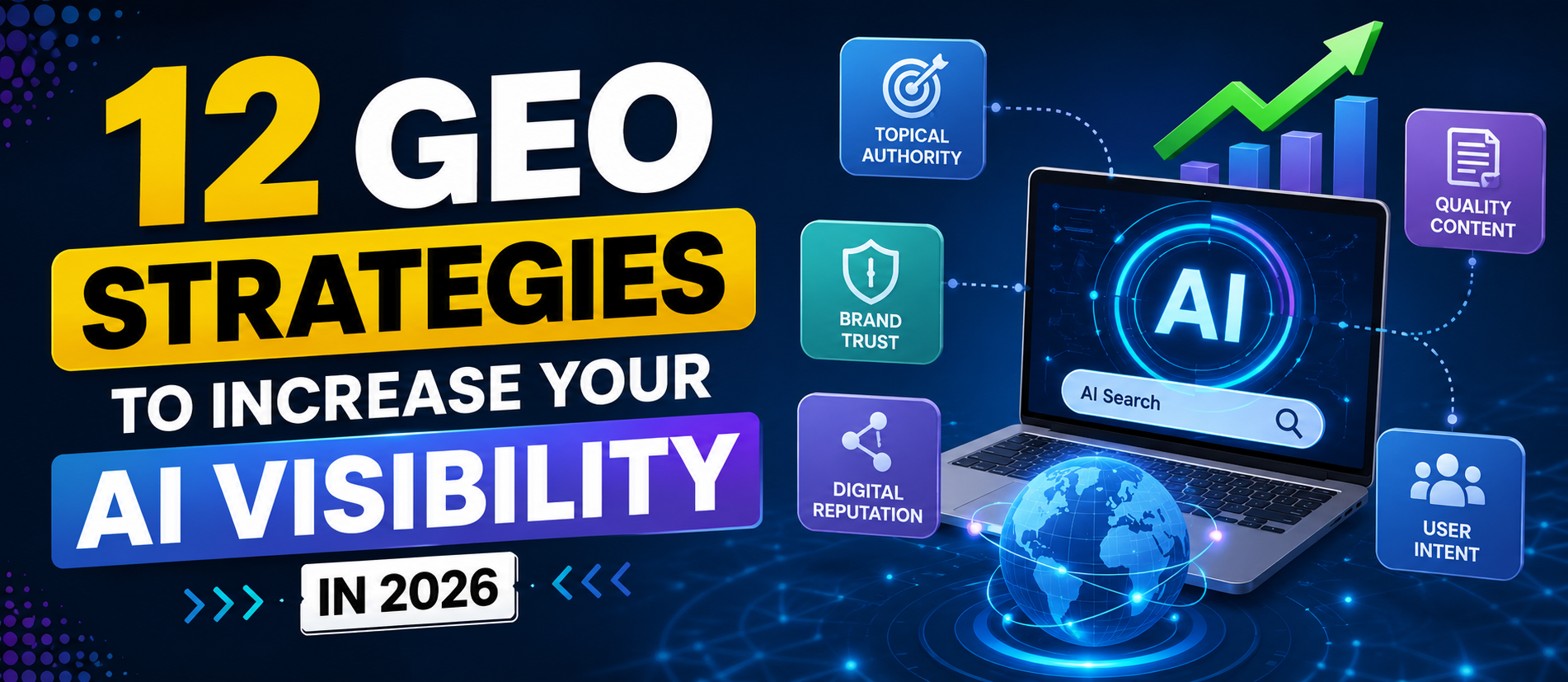
This guide presents twelve practical GEO strategies that help organizations build stronger AI visibility throughout 2026 and beyond. Rather than chasing algorithms, these strategies focus on creating genuine authority that benefits both human audiences and AI-powered discovery systems.
Strategy 1: Build Topic Ecosystems Instead of Publishing Random Articles
Many websites publish isolated blog posts covering unrelated subjects. AI systems, however, prefer websites that demonstrate comprehensive expertise within clearly defined subject areas.
Instead of creating scattered content, organize your website into interconnected topic clusters. Each major subject should include beginner guides, advanced tutorials, FAQs, case studies, industry trends, implementation guides, comparison articles, and practical examples.
When AI consistently observes depth across an entire subject, your brand becomes a stronger candidate for future citations.
Strategy 2: Publish Information That Cannot Be Copied
AI-generated content has flooded the internet, making generic articles increasingly less valuable. The most reliable way to stand out is by publishing information that only your organization can provide.
This includes original research, customer surveys, internal performance data, industry benchmarks, proprietary frameworks, interviews, and unique business experiences.
Original insights are far more likely to earn citations, backlinks, and AI recognition than rewritten information available everywhere else.
Strategy 3: Design Content Around Questions, Not Keywords
Traditional SEO often begins with keyword research. GEO starts with understanding how people naturally ask questions.
Think beyond phrases such as "best CRM software" and instead answer complete questions like:
- Which CRM is best for manufacturing companies?
- How does marketing automation reduce customer acquisition costs?
- Why should startups invest in AI-powered CRM systems?
Conversational content aligns much more closely with AI-generated search experiences.
Strategy 4: Strengthen Your Digital Reputation
AI does not evaluate only your website. It also considers how your business appears throughout the broader web.
Build a trustworthy digital footprint by maintaining accurate business information, publishing expert interviews, contributing guest articles, participating in professional communities, and earning mentions from respected industry publications.
Every credible mention reinforces your brand's authority.
Strategy 5: Turn Every Service Into a Knowledge Hub
Instead of creating short service pages, transform each service into a comprehensive educational resource.
Include implementation guides, common mistakes, FAQs, industry applications, pricing factors, customer success stories, process explanations, and helpful resources.
Pages that educate visitors thoroughly are more useful for both customers and AI systems.
Strategy 6: Use Structured Content Architecture
Artificial Intelligence interprets well-organized information more efficiently than unstructured text.
Organize articles using:
- Clear headings
- Short paragraphs
- Bullet lists
- Comparison tables
- Definitions
- Step-by-step sections
- Frequently Asked Questions
- Summary sections
Readable structure improves user experience while making content easier for AI systems to process.
Strategy 7: Create Author-Centered Content
People trust experts, and AI increasingly evaluates expertise as well.
Whenever possible, include identifiable authors, professional credentials, practical experience, and transparent company information. Educational content written from genuine business experience often carries more authority than anonymous articles.
Demonstrating expertise builds long-term credibility.
Strategy 8: Optimize Every Customer Touchpoint
GEO extends beyond blog articles. Every interaction contributes to your digital authority.
Review your:
- Website
- Knowledge base
- Product documentation
- Email newsletters
- Customer support articles
- Social media profiles
- Video descriptions
- Business directories
Consistent messaging across these assets strengthens AI confidence in your business information.
Strategy 9: Use AI Responsibly
Artificial Intelligence can accelerate content production, but publishing large quantities of lightly edited AI-generated text often reduces long-term value.
Use AI for brainstorming, outlining, editing, summarizing, and research assistance while ensuring every published article includes genuine expertise, practical insights, and human review.
The strongest GEO strategy combines AI efficiency with authentic knowledge.
Strategy 10: Build Citation-Worthy Resources
Ask yourself whether another website—or an AI assistant—would naturally reference your content.
Resources that frequently earn citations include:
- Annual reports
- Industry statistics
- Implementation frameworks
- Research papers
- Technical guides
- Benchmark studies
- Interactive tools
- Educational templates
The more useful your resources become, the more likely they are to influence AI-generated responses.
Strategy 11: Measure Authority Instead of Rankings
Traditional SEO often focuses on keyword positions. GEO requires broader evaluation.
Track indicators such as:
- Brand searches
- Referral traffic
- Industry mentions
- Content citations
- Direct traffic
- Engagement quality
- Returning visitors
- Authority backlinks
These signals provide a more complete picture of digital authority than rankings alone.
Strategy 12: Think Like an Information Source, Not a Marketing Website
The businesses most likely to appear in AI-generated answers are those that consistently educate rather than simply promote.
Become the website that explains industry concepts clearly, publishes reliable research, answers difficult questions, and helps customers solve problems.
When your organization becomes a trusted source of knowledge, visibility across both traditional search engines and AI platforms naturally increases.
Why GEO Complements SEO Instead of Replacing It
Some marketers assume GEO will replace Search Engine Optimization. In reality, both disciplines work together.
Contact UsWhy GEO Complements SEO Instead of Replacing It
Some marketers assume GEO will replace Search Engine Optimization. In reality, both disciplines work together.
SEO improves crawlability, technical performance, page relevance, and organic rankings.
AEO focuses on answering questions clearly for voice assistants and conversational search.
GEO strengthens authority, trust, expertise, and AI visibility across generative search platforms.
Businesses integrating all three strategies create a stronger long-term digital presence than relying on any single optimization method.
Preparing Your Business for AI Search in 2026
Organizations preparing for AI search should invest in continuous content improvement rather than short-term ranking tactics.
Focus on:
- Publishing consistently.
- Updating older content.
- Creating original insights.
- Strengthening Digital PR.
- Improving technical performance.
- Expanding educational resources.
- Maintaining accurate business information.
- Monitoring AI search trends.
Businesses that continuously improve authority will remain competitive as AI search continues evolving.
How Designfo Helps Businesses Build GEO-Ready Digital Strategies
Designfo helps organizations prepare for the future of search by developing integrated SEO, AEO, GEO, AI Search Optimization, Digital PR, content marketing, technical SEO, structured data implementation, marketing automation, and authority-building strategies.
Rather than focusing solely on search rankings, our approach strengthens overall digital credibility so businesses become trusted information sources across search engines, conversational AI assistants, and emerging AI discovery platforms.
Whether you're a startup, eCommerce brand, SaaS company, healthcare organization, educational institution, or enterprise business, Designfo creates customized growth strategies designed for long-term success.
Frequently Asked Questions (FAQ)
What is GEO in digital marketing?
Generative Engine Optimization (GEO) is the process of improving a brand's visibility within AI-generated search experiences by strengthening authority, trust, content quality, and digital reputation.
How is GEO different from SEO?
SEO primarily focuses on ranking web pages in traditional search engines, while GEO focuses on increasing the likelihood that AI systems reference your business within generated answers.
Can small businesses benefit from GEO?
Yes. Businesses of every size can improve AI visibility by publishing authoritative content, maintaining accurate business information, earning trusted mentions, and demonstrating genuine expertise.
Is AI-generated content enough for GEO?
No. AI can assist content creation, but long-term GEO success depends on originality, practical experience, trustworthy information, and consistent authority building.
Conclusion
Generative Engine Optimization is reshaping how businesses approach digital visibility. Instead of competing only for rankings, organizations must now compete for trust. AI platforms increasingly reward businesses that publish original insights, demonstrate expertise, maintain strong digital reputations, and consistently educate their audiences.
The twelve strategies outlined above provide a practical roadmap for strengthening AI visibility while simultaneously improving SEO, AEO, customer trust, and long-term brand authority. Organizations that invest in genuine knowledge rather than algorithm shortcuts will be far better prepared for the next generation of search.
If you're ready to build a future-ready AI visibility strategy, strengthen your GEO foundation, and prepare your business for conversational search, Designfo can help. Our specialists combine SEO, GEO, AI Search Optimization, Digital PR, automation, analytics, and content strategy into customized growth solutions designed for measurable business success.
Visit Designfo: www.designfo.in