Types of Digital Marketing
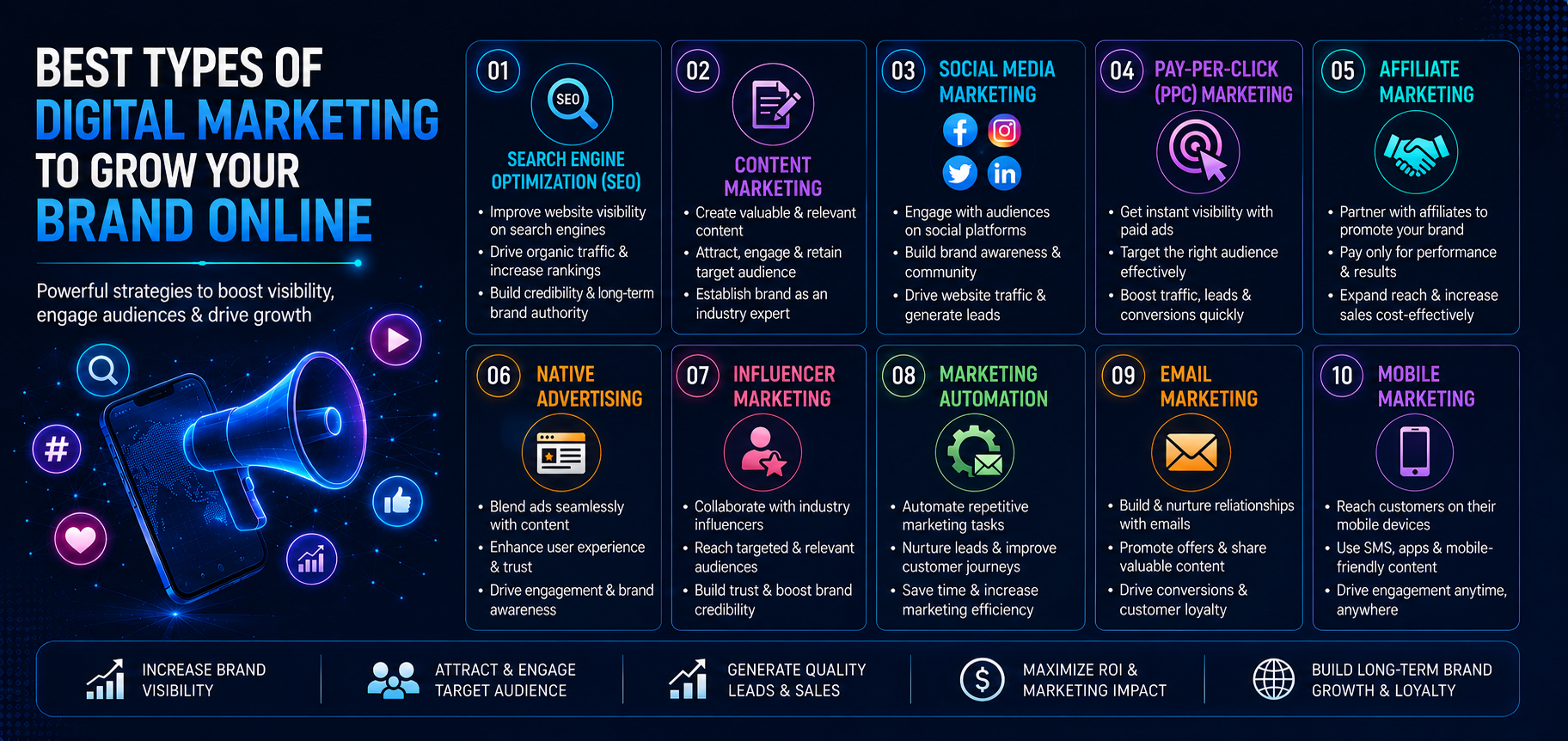
Digital marketing includes a wide range of strategies and techniques that help businesses connect with audiences through online platforms. Since people interact with digital content in many different ways, there are several important forms of digital marketing used by businesses today.
Search Engine Optimization (SEO)
Search Engine Optimization, commonly known as SEO, is one of the most important parts of digital marketing. SEO is the process of improving a website’s visibility on search engines like Google so that potential customers can easily find a business online.
SEO combines technical knowledge, content strategy, and user experience optimization to improve rankings on search engine results pages (SERPs). It involves both creative planning and data-driven analysis to achieve better online visibility.
Some of the major factors that influence SEO performance include:
- Creating original and high-quality content
- Optimizing page titles, URLs, headings, and keywords
- Improving user experience and website engagement
- Building strong and relevant backlinks
- Using proper internal linking structure
- Enhancing website speed and mobile responsiveness
Technical SEO is also a key part of optimization. It focuses on improving the backend structure of a website so search engines can crawl, index, and understand the content more efficiently. Fast-loading pages, mobile-friendly design, secure websites, and clean site architecture all contribute to better SEO performance.
The main objective of SEO is to improve a website’s ranking on search engines and increase organic traffic. Websites that appear on the first page of search results usually receive more visibility, clicks, and potential customers.
Since search engine algorithms are updated regularly, SEO is an ongoing process that requires continuous monitoring, optimization, and strategy updates. Businesses must analyze website performance, track rankings, and adapt to changing search trends to remain competitive online.
Content Marketing
Content marketing is one of the most powerful digital marketing strategies used to attract and engage potential customers through valuable and informative content. Since high-quality content plays a major role in search engine optimization (SEO), content marketing helps businesses improve online visibility while building trust with their audience.
Unlike traditional advertising, content marketing focuses on providing useful information instead of directly promoting products or services. The main objective is to educate, inform, and engage users so they naturally develop interest in a brand and eventually become customers.
Content marketing can include many different formats such as:
- Blog articles
- E-books and digital guides
- Email newsletters
- Videos and podcasts
- Case studies and whitepapers
- Infographics and visual content
- Social media posts
- Downloadable resources and worksheets
Today, businesses of all sizes invest heavily in content marketing because audiences prefer brands that offer helpful and engaging information online. Quality content not only increases website traffic but also improves customer trust, brand awareness, and long-term customer relationships.
Successful content marketing requires a balance between SEO optimization and audience engagement. Content should be optimized for search engines while still being easy to read, informative, and valuable for real users. Businesses often use keyword research, audience insights, and AI-powered tools to create smarter and more targeted content strategies.
Understanding the target audience is one of the most important parts of content marketing. Businesses need to identify who they want to reach, what problems their audience faces, and what type of content will be most useful and engaging for them.
No matter which content format is used, following content marketing best practices is essential. Content should be clear, original, well-structured, error-free, and relevant to the audience’s interests. Most importantly, it should guide users toward the next step, such as contacting the business, subscribing to a newsletter, requesting a consultation, or making a purchase.
Social Media Marketing
Social media marketing is a digital marketing strategy that helps businesses increase brand visibility, attract website traffic, and connect with audiences through online social platforms. It allows companies to promote their products, services, values, and brand identity while building direct communication with potential customers.
With billions of users actively spending time on social media every day, platforms like Facebook, Instagram, LinkedIn, YouTube, and X have become powerful marketing channels for businesses of all sizes.
The best platform for a business depends on its target audience and marketing objectives. For example, professional and B2B businesses often achieve better results on LinkedIn, while fashion, lifestyle, and youth-focused brands may perform better on Instagram or other visual platforms.
One of the biggest advantages of social media marketing is audience interaction. Businesses can communicate directly with users through comments, messages, shares, reactions, and discussions. These interactions help brands understand customer interests, improve engagement, and build stronger relationships with their audience.
Social media marketing also provides valuable performance insights such as reach, engagement rate, clicks, shares, and audience behavior. These analytics help businesses measure campaign success and optimize future marketing strategies more effectively.
For many businesses, the goal of social media marketing is not only direct sales but also long-term brand awareness and customer trust. Some brands focus on starting conversations, educating audiences, or building online communities before encouraging customers to make a purchase.
To create a successful social media marketing strategy, businesses should follow several important practices:
- Create engaging and high-quality content
- Maintain a consistent posting schedule
- Respond to customer comments and messages professionally
- Share content at the most active audience times
- Understand audience behavior and platform preferences
- Use creative visuals, videos, and interactive posts
- Monitor analytics and improve strategies regularly
A strong social media presence can help businesses increase visibility, strengthen customer relationships, and achieve long-term digital marketing success.
Pay-Per-Click (PPC) Marketing
Pay-Per-Click advertising, commonly known as PPC, is a digital marketing method where businesses pay only when someone clicks on their online advertisement. Instead of spending money on fixed advertising placements, advertisers are charged based on actual user interaction with the ad.
One of the most widely used PPC platforms is Google Ads, where businesses bid to display advertisements on search engine results pages. When users search for specific keywords, search engines automatically decide which ads appear based on several important factors, including:
- Ad relevance
- Quality of the advertisement
- Keyword targeting
- Landing page experience
- Bid value and competition
PPC campaigns are designed to encourage users to take specific actions after clicking an ad. These actions, known as conversions, may include product purchases, newsletter subscriptions, contact form submissions, phone calls, or website registrations.
One of the major advantages of PPC marketing is that businesses can easily track campaign performance, monitor conversions, and optimize advertisements for better results and return on investment (ROI).
Affiliate Marketing
Affiliate marketing is a performance-based digital marketing strategy where individuals or businesses earn commissions by promoting another company’s products or services online.
In this system, affiliates share products through blogs, websites, social media, videos, or other digital channels. Whenever a customer completes a purchase through the affiliate’s referral link, the affiliate receives a percentage of the sale.
Some affiliates work with a single brand, while others promote products from multiple businesses across different industries. Companies also create affiliate programs to encourage marketers, bloggers, and influencers to promote their products more effectively.
To build a successful affiliate marketing strategy, businesses should provide affiliates with useful promotional resources such as banners, custom links, marketing materials, and attractive commission incentives.
Native Advertising
Native advertising is a form of paid digital promotion that blends naturally with the surrounding content on a website or platform. Unlike traditional display ads, native ads are designed to look less disruptive and more similar to regular content.
These advertisements often appear as sponsored articles, recommended content, or promoted posts that match the design and style of the platform where they are displayed.
The main purpose of native advertising is to provide useful or entertaining information while subtly promoting a brand or product. However, businesses should always clearly label native advertisements using terms such as “Sponsored” or “Promoted” to maintain transparency and customer trust.
When used correctly, native advertising can improve user engagement without creating an intrusive advertising experience.
Influencer Marketing
Influencer marketing involves collaborating with popular content creators, industry experts, or social media personalities to promote products and services to their followers.
Influencers often have strong audience trust and engagement across platforms like Instagram, YouTube, and Facebook, making them highly effective for increasing brand visibility and reaching new audiences.
This strategy works well for both B2B and B2C businesses. However, selecting the right influencer is extremely important because influencers directly impact brand reputation and customer trust.
Successful influencer partnerships help businesses improve brand awareness, increase engagement, and generate quality leads through authentic recommendations.
Marketing Automation
Marketing automation uses software and technology to streamline and automate digital marketing tasks, helping businesses save time while improving campaign efficiency and customer engagement.
Automation tools allow companies to:
- Track customer behavior and engagement
- Create personalized marketing campaigns
- Schedule emails and social media posts
- Segment audiences automatically
- Send messages based on customer actions
- Analyze campaign performance in real time
Modern consumers expect personalized communication from brands, and marketing automation helps businesses deliver the right message to the right audience at the perfect time.
Automation also improves customer experience by creating targeted interactions without requiring constant manual effort from marketing teams.
Email Marketing
Email marketing is a highly effective digital marketing strategy that involves sending promotional or informative emails directly to potential and existing customers.
Businesses use email marketing for product updates, newsletters, special offers, event promotions, customer engagement, and lead nurturing.
Successful email marketing campaigns focus on personalization and audience targeting. Important elements of a strong email strategy include:
- Personalized subject lines and content
- Mobile-friendly email design
- Easy unsubscribe options
- Audience segmentation
- Scheduled campaigns and automation
- A/B testing for performance improvement
When combined with automation and audience analytics, email marketing can significantly improve customer engagement and conversion rates.
Mobile Marketing
Mobile marketing focuses on reaching customers through smartphones, tablets, and other mobile devices. Since mobile internet usage continues to grow worldwide, businesses increasingly optimize their marketing strategies for mobile users.
Mobile marketing methods may include:
- SMS and MMS marketing
- Mobile app notifications
- Social media promotions
- Mobile-friendly websites
- In-app advertising
- Push notifications
Creating mobile-optimized content is essential because users expect fast-loading pages, responsive designs, and smooth browsing experiences on smaller screens.
A strong mobile marketing strategy helps businesses improve customer engagement, increase accessibility, and reach audiences wherever they are.