- Understanding Customer Relationship Management (CRM)
A Customer Relationship Management system is designed to organize, store, and manage customer information throughout the sales lifecycle. - What Is Marketing Automation?
Marketing Automation software focuses on attracting, engaging, educating, and nurturing potential customers before they become buyers. - The Fundamental Difference
The simplest way to understand the distinction is to consider the customer journey. - How Marketing Automation Works
Marketing Automation platforms continuously monitor customer activity across digital channels.
As businesses become increasingly digital, managing customer relationships and marketing campaigns efficiently has become essential for sustainable growth. Whether you operate a startup, an eCommerce business, a SaaS company, or a large enterprise, you have likely encountered two common technologies—Customer Relationship Management (CRM) software and Marketing Automation platforms.
Although these technologies are frequently mentioned together, they are designed to solve different business challenges. Many organizations mistakenly assume they perform the same functions, leading to poor software selection, inefficient workflows, and missed growth opportunities.
The reality is that CRM and Marketing Automation are complementary systems rather than competing solutions. A CRM helps businesses organize customer relationships and sales activities, while Marketing Automation focuses on attracting prospects, nurturing leads, and delivering personalized communication automatically.
Understanding how these technologies different and how they work together can help businesses improve customer engagement, increase sales efficiency, and build scalable marketing systems. This guide explains the differences, practical applications, benefits, and integration strategies while incorporating modern SEO, AEO, GEO, and AI Search Optimization best practices.
Understanding Customer Relationship Management (CRM)
A Customer Relationship Management system is designed to organize, store, and manage customer information throughout the sales lifecycle. It acts as a centralized database where businesses record interactions, track opportunities, manage contacts, schedule follow-ups, and monitor sales performance.
Sales representatives rely on CRM software to understand where every prospect stands in the buying process. Instead of searching through emails or spreadsheets, teams can instantly access customer history, previous conversations, quotations, invoices, and support interactions from one location.
The primary objective of a CRM is to strengthen customer relationships while improving sales productivity and operational visibility.
What Is Marketing Automation?
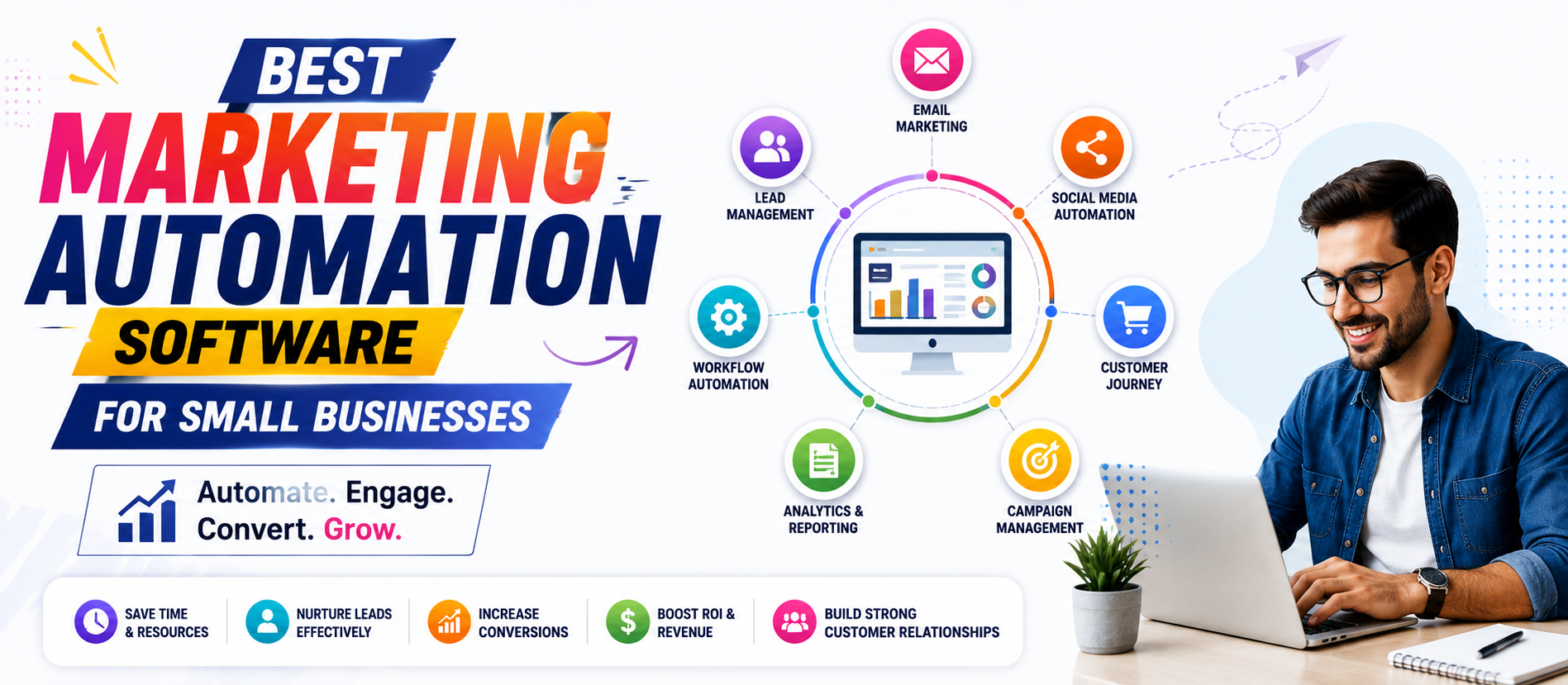
Marketing Automation software focuses on attracting, engaging, educating, and nurturing potential customers before they become buyers. Rather than organizing customer records, these platforms automate communication based on customer behavior, predefined workflows, or Artificial Intelligence.
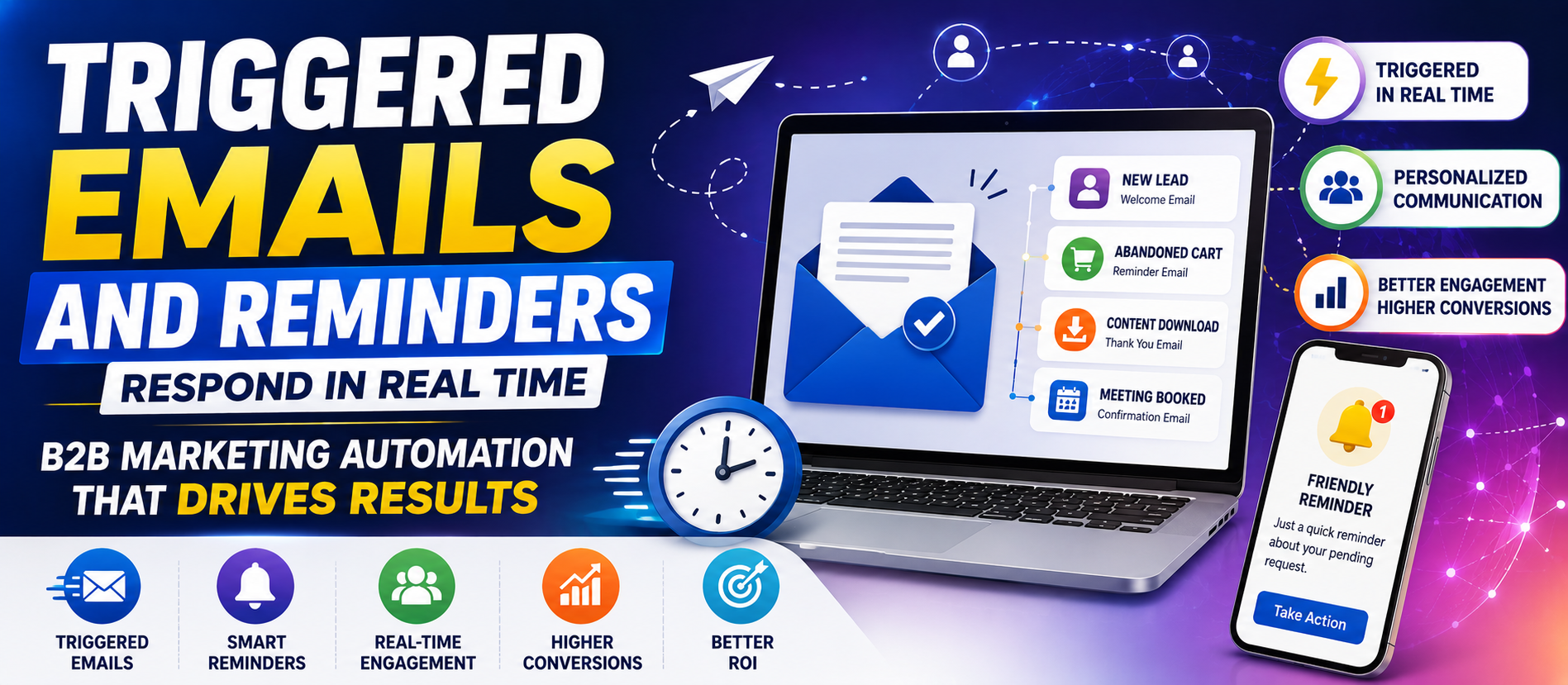
For example, if someone downloads an eBook, registers for a webinar, abandons a shopping cart, or requests a quotation, the automation platform can immediately trigger personalized emails, WhatsApp messages, SMS reminders, educational content, or promotional offers without requiring manual intervention.
The goal is to guide prospects toward making informed purchasing decisions while reducing repetitive marketing tasks.
The Fundamental Difference
The simplest way to understand the distinction is to consider the customer journey.
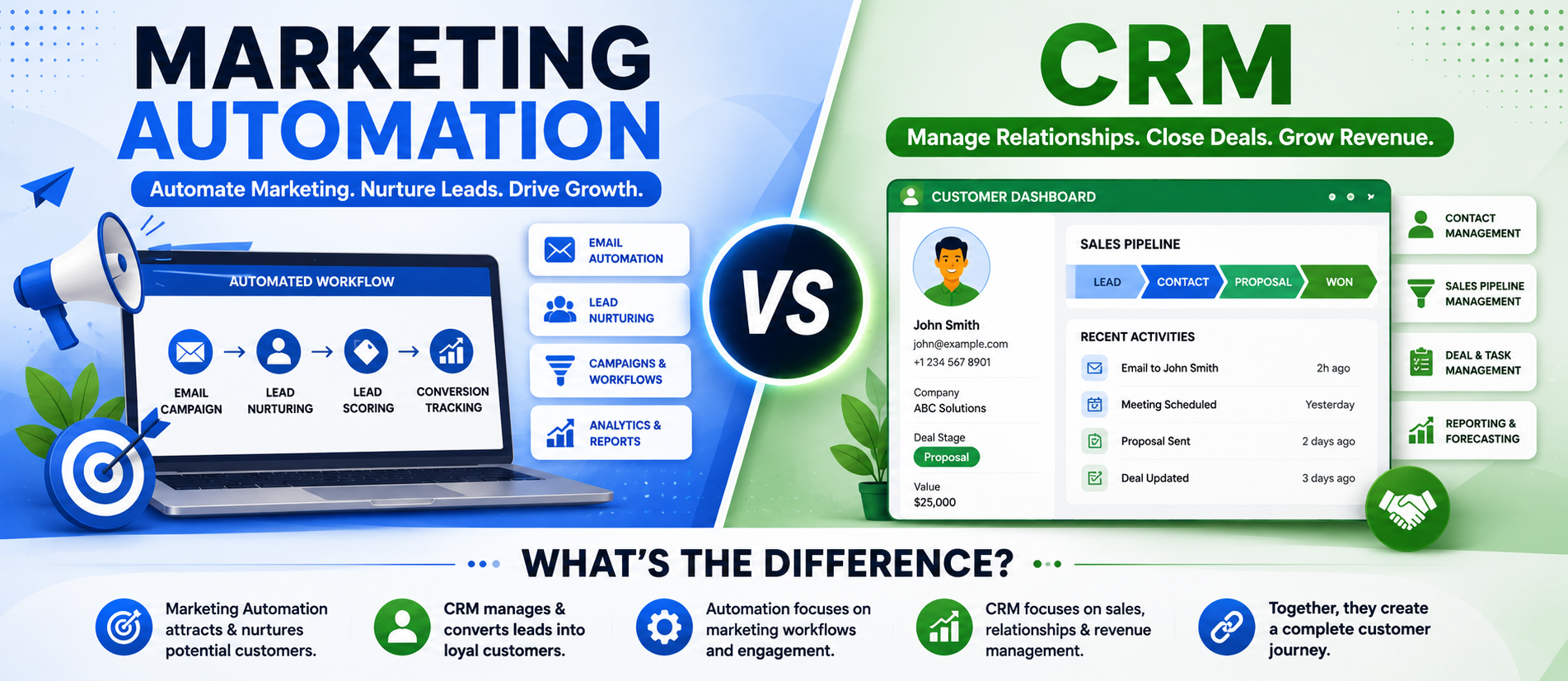
Marketing Automation primarily supports prospects before they become customers. It generates awareness, nurtures interest, educates buyers, and encourages engagement.
CRM software becomes increasingly valuable after meaningful customer interactions begin. It helps sales teams manage conversations, negotiate opportunities, monitor pipelines, and maintain long-term customer relationships.
One system creates demand, while the other manages relationships resulting from that demand.
How Marketing Automation Works
Typical automation activities include:
- Email drip campaigns
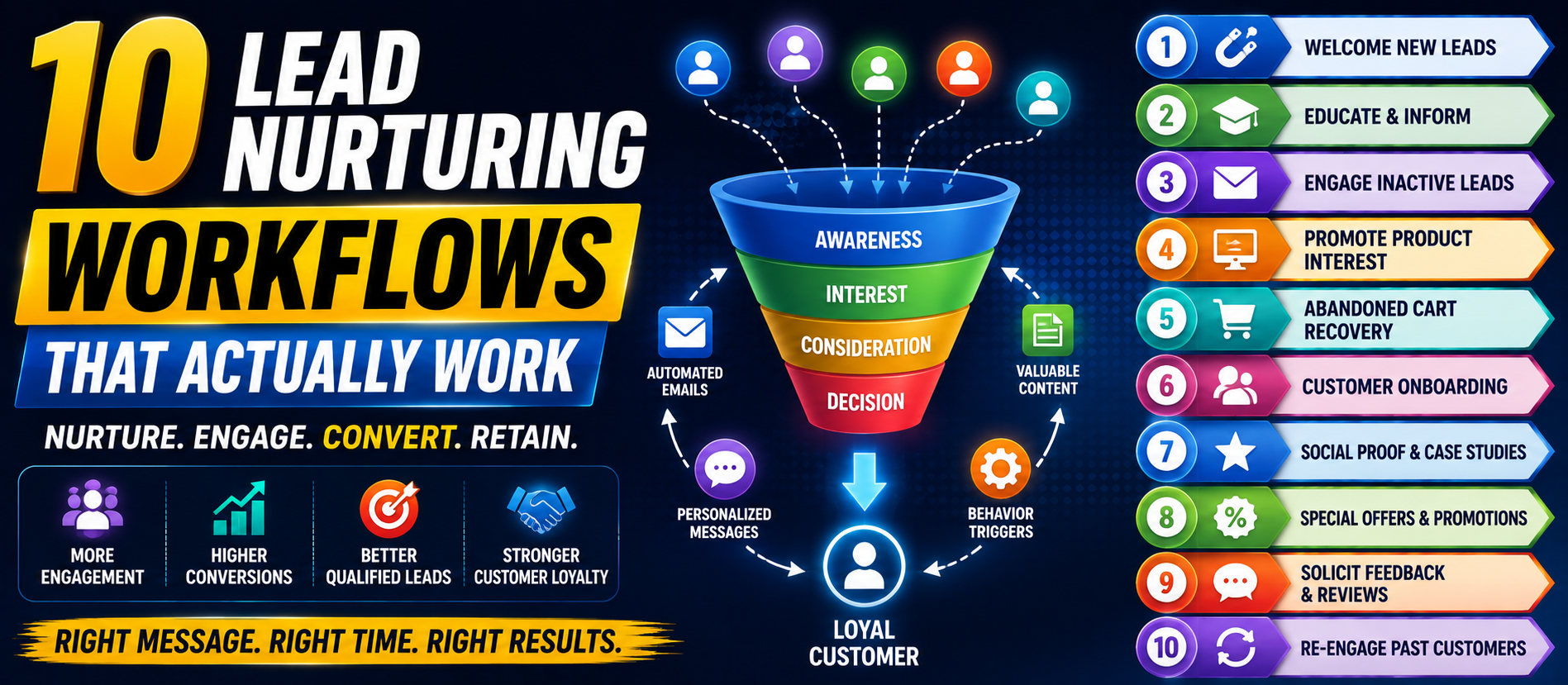
- Lead nurturing workflows
- Landing page integration
- Newsletter distribution
- Behavior-based messaging
- Social media scheduling
- Lead scoring
- Campaign analytics
Instead of relying on fixed schedules, communication adapts dynamically according to customer behavior, interests, and engagement patterns.
How CRM Software Works
CRM systems organize customer information throughout the sales and service lifecycle.
Common CRM functions include:
- Contact management
- Sales pipeline tracking
- Opportunity management
- Quotation management
- Task scheduling
- Customer support records
- Meeting history
- Sales forecasting
This centralized information enables sales teams to collaborate efficiently while maintaining complete visibility into every customer relationship.
Why Businesses Benefit from Using Both
Many high-performing organizations combine Marketing Automation with CRM rather than choosing one over the other.
Consider a practical example:
A visitor downloads an industry report from your website. Marketing Automation immediately delivers educational emails, case studies, and webinar invitations over several weeks. As the prospect demonstrates stronger buying intent by visiting pricing pages or requesting a consultation, the lead is automatically transferred into the CRM.
The sales team now receives a qualified lead with complete engagement history, allowing them to conduct more informed conversations and increase the likelihood of closing the opportunity.
This seamless handoff significantly improves both marketing efficiency and sales effectiveness.
The Role of Artificial Intelligence
Artificial Intelligence has enhanced both Marketing Automation and CRM platforms.
Within Marketing Automation, AI helps generate personalized content, predict customer interests, optimize campaign timing, recommend audience segments, and improve lead scoring.
The Role of Artificial Intelligence
Artificial Intelligence has enhanced both Marketing Automation and CRM platforms.
Within Marketing Automation, AI helps generate personalized content, predict customer interests, optimize campaign timing, recommend audience segments, and improve lead scoring.
Contact UsWithin CRM systems, AI assists sales representatives by forecasting revenue, identifying high-value opportunities, recommending follow-up actions, summarizing customer conversations, and highlighting potential risks within the sales pipeline.
AI transforms both platforms into intelligent business decision-support systems.
Choosing the Right Solution
Your business objectives determine which technology should receive priority.
If your primary challenge is generating qualified leads, nurturing prospects, and automating marketing campaigns, Marketing Automation will likely deliver the greatest immediate value.
If your organization struggles to manage customer relationships, coordinate sales activities, or organize client information, implementing a CRM should become the first priority.
Businesses experiencing rapid growth often benefit most from integrating both systems into one connected ecosystem.
Marketing Automation and CRM Integration
Integration eliminates the traditional gap between marketing and sales.
When both platforms exchange information automatically:
- Marketing identifies qualified prospects.
- CRM receives complete engagement history.
- Sales representatives prioritize active opportunities.
- Customer interactions remain synchronized.
- Follow-ups become more personalized.
- Reporting becomes more accurate.
- Departments collaborate more effectively.
- Customer experiences improve significantly.
Integrated systems reduce manual work while providing better visibility into every stage of the customer journey.
SEO, AEO & GEO Considerations
Search Engine Optimization (SEO)
Marketing Automation distributes valuable content that attracts search traffic, while CRM helps convert visitors into long-term customers. Together they support sustainable organic growth.
Answer Engine Optimization (AEO)
Automation workflows can deliver educational resources that answer common customer questions, improving visibility within conversational search experiences.
Generative Engine Optimization (GEO)
Publishing authoritative content and maintaining consistent customer communication strengthens brand credibility across AI-powered search platforms and generative search systems.
Common Misconceptions
- CRM is not an email marketing platform.
- Marketing Automation is not a sales management system.
- Automation does not replace human sales conversations.
- CRM alone does not generate new leads.
- Marketing Automation cannot replace customer relationship management.
- AI enhances both systems but does not eliminate human decision-making.
- Integration usually delivers better results than using either platform independently.
- Successful implementation depends on business strategy rather than software alone.
How Designfo Helps Businesses Implement CRM & Marketing Automation
Designfo specializes in building integrated CRM and Marketing Automation ecosystems that combine AI-powered workflows, customer journey mapping, lead nurturing, SEO, analytics, WhatsApp automation, email marketing, sales optimization, and workflow automation.
Our customized solutions help businesses automate repetitive processes, improve collaboration between marketing and sales teams, generate higher-quality leads, increase customer retention, and build scalable digital growth systems.
Whether you need a CRM implementation, marketing automation platform, or a fully integrated business solution, Designfo develops strategies tailored to your organization.
Frequently Asked Questions (FAQ)
Can Marketing Automation replace a CRM?
No. Marketing Automation and CRM perform different functions. Automation focuses on generating and nurturing leads, while CRM manages customer relationships and sales activities.
Do small businesses need both systems?
Many small businesses begin with one solution based on immediate priorities, but integrating both platforms often becomes valuable as customer databases and marketing activities expand.
Does AI improve CRM and Marketing Automation?
Yes. AI enhances personalization, predictive analytics, lead scoring, customer insights, sales forecasting, workflow optimization, and campaign performance across both systems.
Which solution should be implemented first?
The answer depends on your business goals. Organizations focused on lead generation often begin with Marketing Automation, while businesses emphasizing sales management frequently prioritize CRM implementation.
Conclusion
Marketing Automation and CRM are not competing technologies—they are complementary components of a successful digital growth strategy. Marketing Automation attracts and nurtures potential customers, while CRM helps sales teams build lasting relationships and convert opportunities into revenue. Together, they create a seamless customer journey that supports sustainable business growth.
As Artificial Intelligence continues transforming digital marketing, integrating these platforms becomes even more valuable. Businesses that combine automation, customer intelligence, personalized communication, and AI-powered insights gain a significant competitive advantage in today's increasingly data-driven marketplace.
If you're ready to implement CRM, Marketing Automation, AI-powered workflows, or a fully integrated customer engagement ecosystem, Designfo can help. Our experts develop customized solutions that combine digital marketing, SEO, CRM, AI, analytics, and workflow automation to help businesses achieve measurable long-term success.
Visit Designfo: www.designfo.in