- What Is Marketing Automation Software?
Marketing automation software is a platform that automates repetitive marketing activities while helping businesses build stronger customer relationships. - Why Businesses Invest in Marketing Automation
Customers interact with brands through multiple digital channels before making purchasing decisions. - Key Evaluation Criteria
Before comparing individual platforms, establish clear evaluation criteria based on business priorities. - Leading Marketing Automation Platforms in 2026
HubSpot Marketing Hub
Marketing automation has matured from a simple email scheduling solution into a comprehensive business technology that powers customer acquisition, lead nurturing, sales enablement, customer retention, and data-driven decision-making. Whether you're operating an eCommerce store, a SaaS company, a healthcare organization, or a B2B enterprise, automation platforms now play a central role in delivering personalized customer experiences at scale.
The software market has expanded significantly, offering solutions designed for startups, growing businesses, agencies, and global enterprises. Each platform has unique strengths, integration options, AI capabilities, and pricing models. Choosing the right solution requires more than comparing feature lists—it requires understanding how each platform fits your business objectives and long-term growth strategy.
This guide compares today's leading marketing automation platforms, explains what features matter most, and provides a practical framework for selecting software that supports SEO, Answer Engine Optimization (AEO), Generative Engine Optimization (GEO), and AI-powered marketing.
What Is Marketing Automation Software?
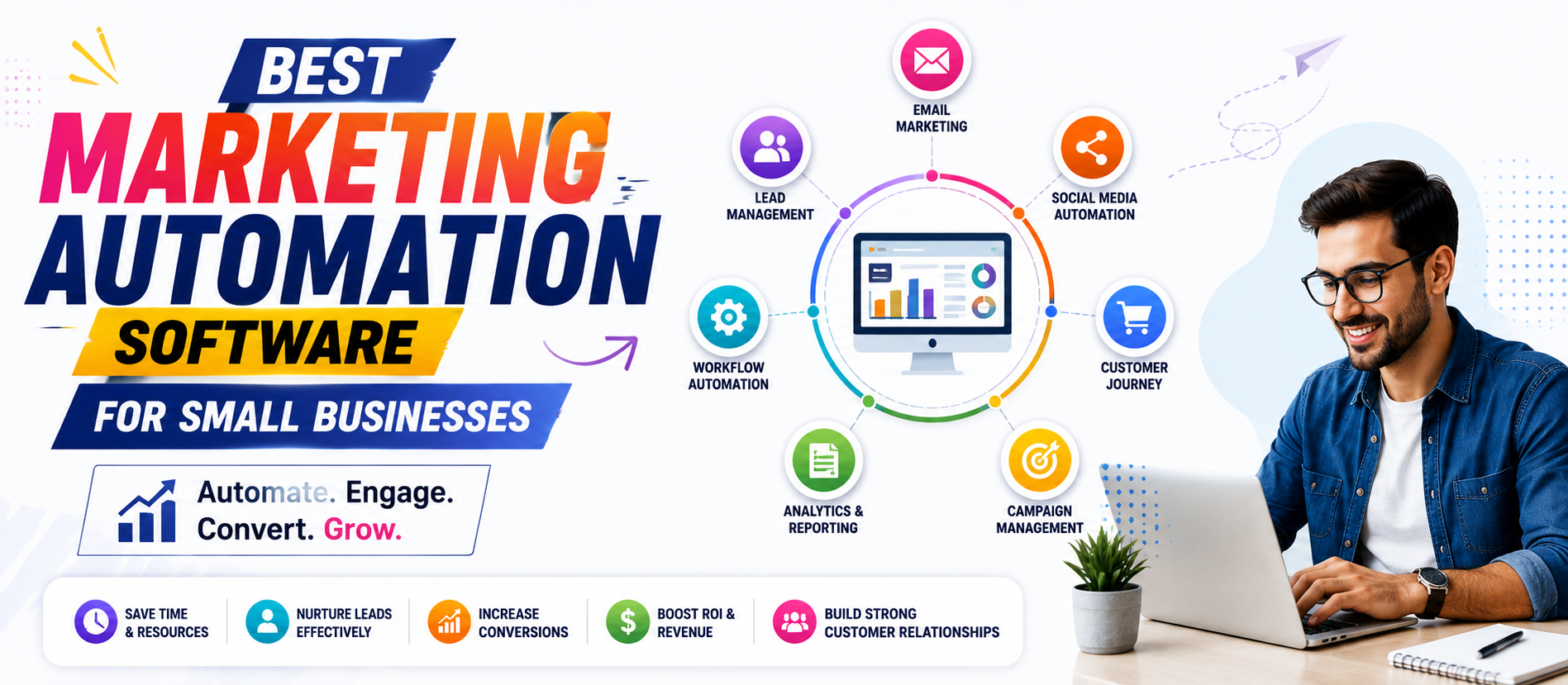
Marketing automation software is a platform that automates repetitive marketing activities while helping businesses build stronger customer relationships. Instead of manually sending emails, assigning leads, updating customer records, scheduling campaigns, or monitoring engagement, automation software performs these tasks according to predefined workflows and customer behavior.
Modern platforms integrate with websites, CRM systems, online stores, advertising platforms, customer support tools, analytics dashboards, and messaging applications to create a unified marketing ecosystem.
The primary goal is to improve efficiency while delivering timely, personalized communication that increases conversions.
Why Businesses Invest in Marketing Automation
Customers interact with brands through multiple digital channels before making purchasing decisions. They may discover your website through search engines, subscribe to newsletters, engage on social media, request demonstrations, download guides, or communicate through messaging platforms.
Managing every interaction manually becomes increasingly difficult as customer databases grow. Automation ensures every customer receives relevant communication without increasing administrative workload.
Organizations benefit from faster response times, improved lead management, stronger customer engagement, and more predictable sales processes.
Key Evaluation Criteria
Before comparing individual platforms, establish clear evaluation criteria based on business priorities.
- Workflow automation flexibility
- CRM integration
- Email marketing capabilities
- Lead scoring
- Customer segmentation
- Artificial Intelligence features
- Reporting and analytics
- Third-party integrations
- Scalability
- User experience
- Customer support
- Total cost of ownership
Evaluating software against consistent criteria makes comparisons more meaningful than focusing solely on feature quantity.
Leading Marketing Automation Platforms in 2026
HubSpot Marketing Hub
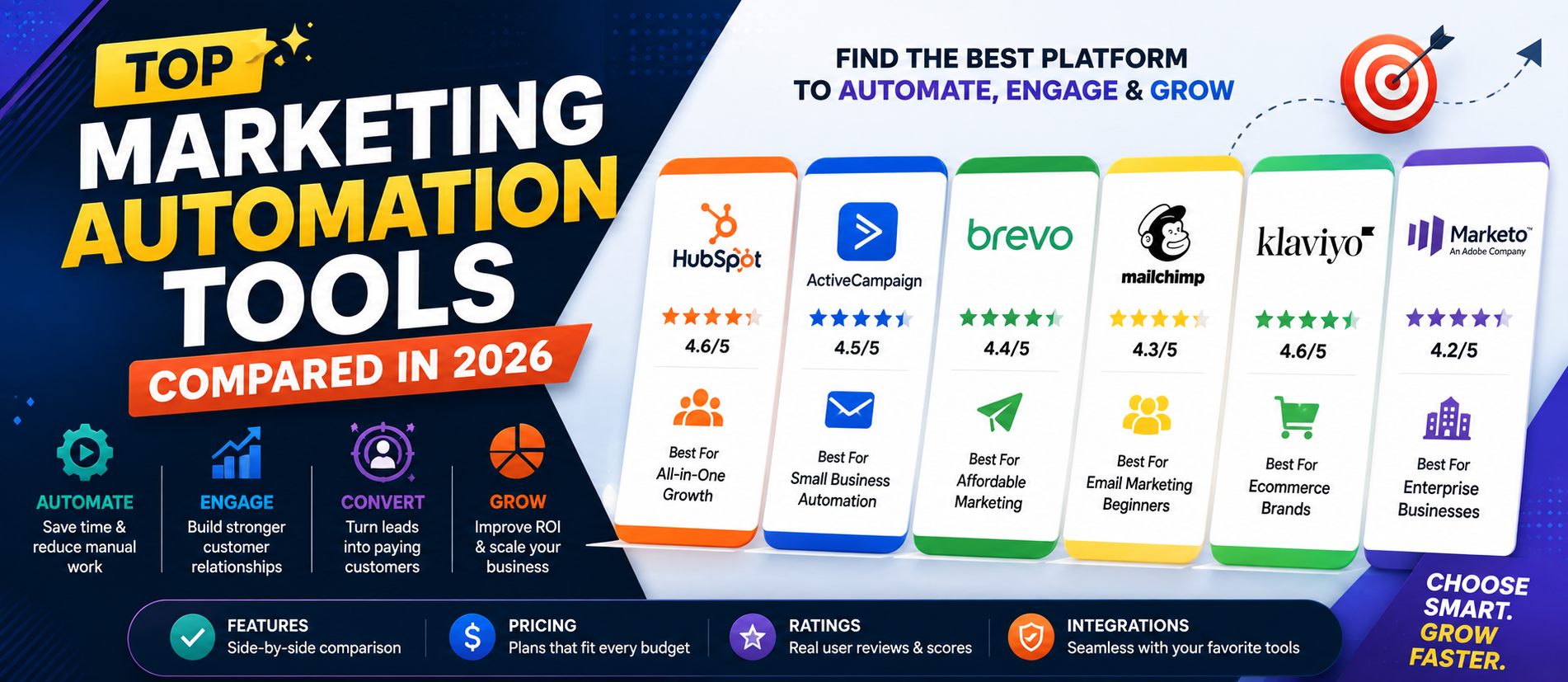
HubSpot remains a popular all-in-one platform combining CRM, email marketing, landing pages, automation workflows, analytics, content management, and customer service tools. It is particularly attractive for businesses seeking a unified environment without extensive technical complexity.
Adobe Marketo Engage
Marketo is designed for organizations managing sophisticated B2B marketing campaigns. Its strengths include advanced lead nurturing, account-based marketing, campaign orchestration, and enterprise-level automation.
Salesforce Marketing Cloud
Organizations already using Salesforce CRM often benefit from its native marketing ecosystem, enabling highly personalized customer journeys across multiple communication channels.
ActiveCampaign
ActiveCampaign combines email marketing, CRM functionality, automation workflows, and behavioral targeting, making it suitable for small and medium-sized businesses seeking advanced automation without enterprise complexity.
Brevo
Brevo provides a balanced combination of email marketing, SMS campaigns, automation workflows, CRM features, and transactional messaging, making it attractive for growing businesses with diverse communication needs.
Mailchimp
Mailchimp continues to serve startups and small businesses with intuitive email marketing, basic automation, audience management, and reporting capabilities while expanding its AI-assisted content features.
Klaviyo
Klaviyo focuses primarily on eCommerce marketing, offering deep integration with online stores, customer segmentation, predictive analytics, and personalized product recommendations.
Zoho Marketing Automation
Organizations already using Zoho products often benefit from seamless integration between marketing, CRM, finance, and customer support systems.
Artificial Intelligence Is Redefining Automation
Artificial Intelligence has become one of the most important differentiators among marketing platforms. Rather than simply automating repetitive tasks, AI enables systems to make intelligent recommendations based on customer behavior and campaign performance.

Artificial Intelligence Is Redefining Automation
Artificial Intelligence has become one of the most important differentiators among marketing platforms. Rather than simply automating repetitive tasks, AI enables systems to make intelligent recommendations based on customer behavior and campaign performance.
Contact UsCommon AI capabilities now include:
- Predictive lead scoring
- Automated audience segmentation
- Email content generation
- Subject line optimization
- Send-time recommendations
- Customer journey analysis
- Campaign performance forecasting
- Behavioral personalization
Businesses adopting AI-enhanced automation often achieve higher engagement while reducing manual optimization efforts.
Which Platform Fits Different Business Types?
No single platform is ideal for every organization.
Startups generally prioritize affordability, ease of implementation, and essential automation features.
Growing companies often require stronger CRM integration, lead nurturing, and multi-channel communication.
Large enterprises typically focus on scalability, governance, advanced analytics, and complex workflow management.
eCommerce businesses benefit from platforms emphasizing customer segmentation, abandoned cart recovery, and product recommendation engines.
The best software aligns with your operational requirements rather than simply offering the largest number of features.
Implementation Considerations
Successful marketing automation depends as much on implementation as software selection.
Before deployment, businesses should:
- Define customer journey stages.
- Organize contact databases.
- Create audience segments.
- Develop automation workflows.
- Prepare content libraries.
- Configure CRM integration.
- Train marketing teams.
- Establish reporting dashboards.
A well-planned implementation delivers better long-term results than rapidly deploying complex automation without clear objectives.
Supporting SEO, AEO & GEO
Search Engine Optimization (SEO)
Marketing automation complements SEO by distributing educational content, increasing repeat website visits, promoting new resources, and strengthening customer engagement over time.
Answer Engine Optimization (AEO)
Automation workflows can deliver concise educational resources that answer common customer questions, supporting visibility in conversational search experiences.
Generative Engine Optimization (GEO)
Publishing authoritative content consistently and distributing it through intelligent marketing campaigns strengthens topical authority, improving visibility across AI-powered discovery platforms.
Common Buying Mistakes
- Choosing software based only on popularity.
- Ignoring integration requirements.
- Underestimating implementation effort.
- Paying for unused enterprise features.
- Overlooking reporting capabilities.
- Neglecting user training.
- Failing to define automation goals.
- Ignoring long-term scalability.
The right platform should simplify operations while supporting future business growth.
How Designfo Helps Businesses Choose and Implement Marketing Automation
Designfo helps businesses evaluate, implement, and optimize marketing automation platforms that align with their growth objectives. Our services include automation strategy, CRM integration, AI-powered workflows, customer journey design, SEO, content marketing, analytics, WhatsApp automation, email marketing, and digital transformation consulting.
Rather than recommending a one-size-fits-all solution, we assess business requirements, existing technology, customer journeys, and operational goals before designing scalable automation ecosystems.
Frequently Asked Questions (FAQ)
Which marketing automation platform is best in 2026?
The best platform depends on your business size, marketing objectives, budget, technical requirements, and integration needs. There is no universal solution for every organization.
Should small businesses invest in marketing automation?
Yes. Even modest automation workflows can improve lead nurturing, customer communication, and operational efficiency while supporting long-term growth.
How important is AI when selecting a platform?
AI is becoming increasingly valuable because it enhances personalization, customer segmentation, predictive analytics, workflow optimization, and campaign performance analysis.
Can marketing automation improve customer retention?
Absolutely. Automated onboarding, personalized follow-ups, loyalty campaigns, renewal reminders, and educational content all contribute to stronger customer relationships and higher lifetime value.
Conclusion
Choosing a marketing automation platform is a strategic business decision rather than simply a software purchase. The most successful organizations evaluate automation tools according to their customer journey, internal workflows, growth plans, AI capabilities, and integration requirements instead of focusing only on feature comparisons.
As digital marketing continues evolving, businesses that combine intelligent automation, customer-centric communication, AI-powered insights, SEO, and data-driven decision-making will build stronger customer relationships while achieving sustainable competitive advantages.
If you're planning to implement or upgrade your marketing automation ecosystem, Designfo can help. Our specialists design customized automation strategies that integrate CRM, AI, SEO, analytics, workflow automation, and digital marketing into scalable systems built for measurable business growth.
Visit Designfo: www.designfo.in