Every marketing team dreams of launching a successful content campaign that drives traffic, engagement, leads, and long-term brand authority. But in reality, not every campaign succeeds.
Some campaigns quietly underperform.
Others fail dramatically.
Some get canceled halfway through.
In modern digital marketing, campaign failure is more common than most businesses admit.
At Designfo, we believe failed campaigns are not signs of weakness. Instead, they are opportunities to learn, optimize, and build smarter marketing systems.
Recent industry discussions increasingly show that modern content operations are becoming more complex due to AI disruption, changing audience behavior, platform instability, and rising content saturation.
Why Content Campaigns Get Canceled
Many businesses assume campaigns fail only because of poor creativity.
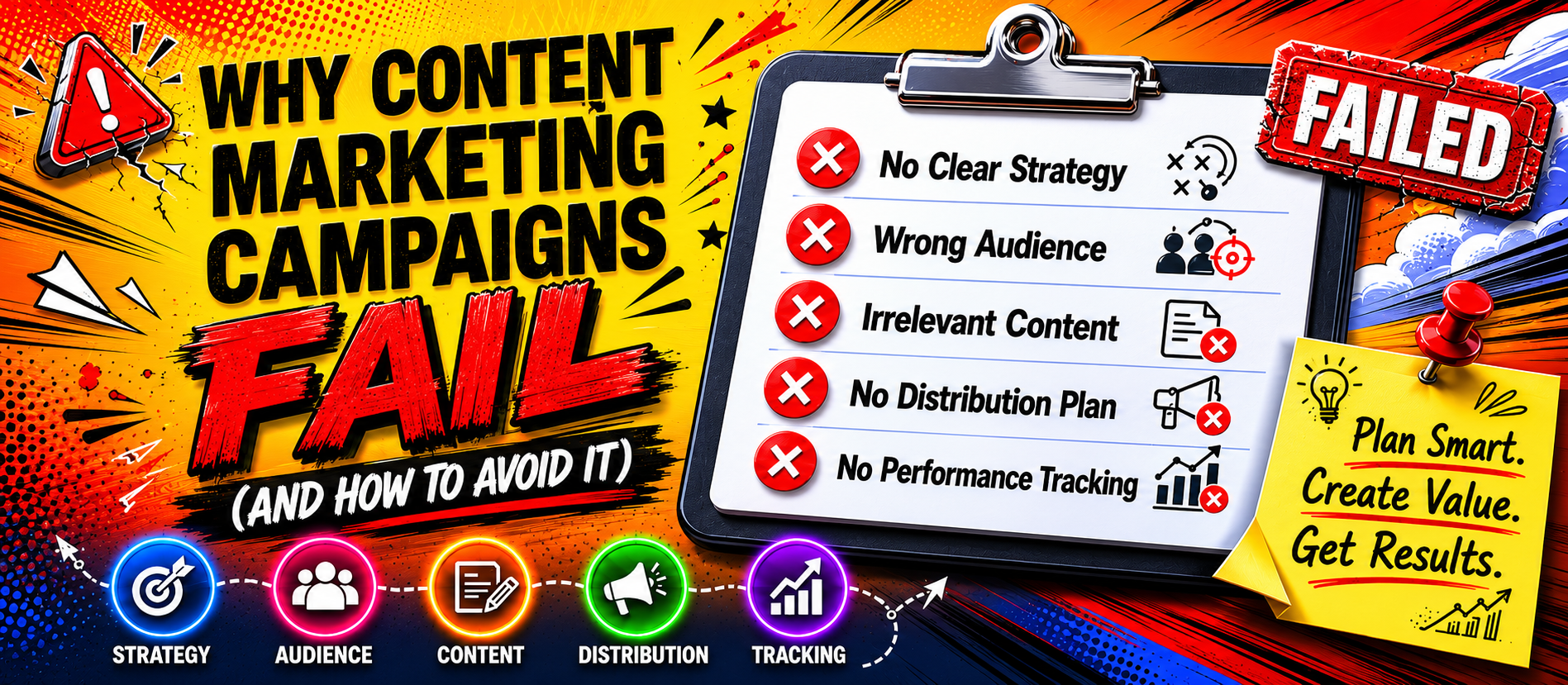
But campaign cancellation usually happens because of deeper operational issues such as:
- Weak strategic planning
- Poor audience targeting
- Unrealistic expectations
- Budget problems
- Internal communication gaps
- Lack of measurable KPIs
- Changing business priorities
- AI-driven market shifts
In many organizations, content teams also face pressure to produce massive amounts of content quickly, often sacrificing quality and strategic clarity.
This creates campaigns that look active but fail to generate meaningful results.
The Biggest Content Marketing Challenge in 2026
The content landscape has changed dramatically.
Today businesses compete against:
- AI-generated content
- Short-form video dominance
- Zero-click search results
- Social media algorithm changes
- Information overload
- Reduced audience attention spans
This means:
Publishing more content alone is no longer enough.
Modern content marketing now requires:
- Strategic differentiation
- Strong brand authority
- Audience trust
- AI-search visibility
- Cross-platform engagement
- Clear operational systems
At Designfo, we see content operations becoming just as important as content creativity itself.
What Is Content Operations?
Content operations refer to the systems, workflows, processes, tools, and team structures that support content creation and distribution.
- Strong content operations include: Editorial planning, Workflow management, Approval systems, SEO optimization, AI integration, Performance tracking, Team collaboration, Publishing consistency
Without proper content operations, even great ideas can fail.
Common Reasons Content Campaigns Fail
1. Lack of Clear Goals
Many campaigns launch without defining:
- Target audience
- Conversion objectives
- SEO goals
- Brand positioning
- Success metrics
Without clear direction, teams create content that generates activity but not actual business growth.
2. Weak Audience Understanding
Modern audiences expect relevance.
Campaigns often fail because brands:
- Misunderstand customer intent
- Ignore audience pain points
- Create generic messaging
- Follow trends blindly
At Designfo, we strongly believe successful content begins with deep audience research.
Because:
Relevant content outperforms mass-produced content.
3. Poor Content Distribution
Creating content is only half the job.
Many campaigns fail because businesses:
- Publish content once
- Ignore repurposing
- Depend only on Google traffic
- Neglect social distribution
- Ignore AI-search optimization
Modern content needs multi-platform visibility.
This includes:
- Search engines
- AI assistants
- LinkedIn
- YouTube
- Instagram
- TikTok
- Reddit
- Email marketing
Without proper distribution, even excellent content remains invisible.
4. Over-Reliance on AI Content
AI tools can dramatically improve productivity.
But many businesses misuse AI by:
- Publishing low-quality AI articles
- Removing human creativity
- Ignoring brand voice
- Sacrificing originality
As AI-generated content floods the internet, authentic expertise becomes more valuable.
At Designfo, we recommend using AI to enhance workflows — not replace strategic thinking.
5. Inconsistent Brand Messaging
Content campaigns often collapse when messaging becomes inconsistent across:
- Blogs
- Social media
- Video content
- Email campaigns
- Advertising
Customers trust brands that communicate clearly and consistently.
Strong branding improves:
- Recognition
- Authority
- Engagement
- Conversion performance
How Smart Brands Recover After Failed Campaigns
Campaign failure does not mean the entire strategy is broken.
Successful businesses treat failed campaigns as data.
They analyze:
- What worked
- What failed
- Audience behavior
- Traffic patterns
- Engagement metrics
- Conversion bottlenecks
Then they improve the system.
At Designfo, we believe adaptive marketing is one of the most important competitive advantages in the AI era.
The Rise of Agile Content Marketing
Traditional marketing campaigns often followed rigid long-term plans.
Modern content systems are becoming more agile.
Agile marketing focuses on:
- Fast experimentation
- Continuous improvement
- Data-driven optimization
- Flexible workflows
- Real-time audience feedback
This allows brands to:
- Adjust strategies quickly
- Improve messaging faster
- Respond to trends efficiently
- Reduce campaign risk
Why Ai Is Changing Content Operations
AI is transforming nearly every stage of content production.
Modern AI systems now assist with:
- Keyword research
- Content ideation
- SEO analysis
- Content optimization
- Personalization
- Workflow automation
- Analytics reporting
However, AI also increases competition dramatically.
Businesses now publish more content than ever before.
This creates a major challenge:
How do brands stand out?
At Designfo, we believe the answer lies in combining:
- Human creativity
- Technical SEO
- AI optimization
- Brand authority
- Structured content systems
Content Quality Now Matters More Than Quantity
For years, many businesses focused heavily on publishing volume.
But modern search systems increasingly prioritize:
- Relevance
- Expertise
- Authority
- Trustworthiness
- User experience
- Structured information
Search engines and AI systems now evaluate:
- Context
- Semantic relationships
- Content usefulness
- Brand reputation
- User engagement signals
This means low-quality mass content strategies are becoming less effective.
How Designfo Approaches Modern Content Marketing
📋 Quick Summary
- Search-optimized structures
- Human-centered storytelling
- Entity-based SEO
- Multi-platform visibility
- Adaptive content operations
- Semantic content architecture
- AI visibility optimization
- Audience-focused messaging
- Intelligent distribution systems
- Content operations efficiency
- At Designfo, we focus on building:
- Search-optimized structures
- Human-centered storytelling
- Entity-based SEO
- Multi-platform visibility
- Adaptive content operations
- Our strategy combines:
- Semantic content architecture
- AI visibility optimization
- Audience-focused messaging
- Intelligent distribution systems
- Because future digital growth depends on both:
- Content operations efficiency
The Future of Content Marketing
Content marketing is entering a major transformation phase.
The future belongs to brands that:
- Build trust
- Create original insights
- Adapt quickly
- Optimize for AI discovery
- Maintain consistent authority
- Develop intelligent workflows
Businesses that continue relying only on:
- Generic blog posts
- Mass AI content
- Basic keyword stuffing
will struggle increasingly in modern search ecosystems.
Final Thoughts
Canceled or failed campaigns are not the end of content marketing success.
In many cases, they reveal:
- Operational weaknesses
- Audience misunderstandings
- Strategic gaps
- Workflow inefficiencies
The smartest businesses use these lessons to evolve.
At Designfo, we believe the future of content marketing belongs to brands that successfully combine:
- Human creativity
- AI-enhanced workflows
- Strategic operations
- Technical SEO
- Audience trust
- Intelligent adaptation
Because modern marketing success is no longer about producing the most content.
It is about creating the most meaningful, trusted, and strategically optimized digital experiences.